
Updated 4 November 2026 · 14 min read
Central Bengaluru · City Guide · 2026
Is Bangalore Good to Live or Invest In? The View From the Centre of the City (2026)
Core versus IT-corridor living, 2026 property prices, rental yields, the best areas, the risks and who should buy, written from Lal Bagh Main Road.
Contents
Most answers to “is Bangalore good to live or invest in?” are written from the IT corridors, because that is where the new launches are. This one is written from Lal Bagh Main Road, in the part of the city that stopped adding land decades ago.
The distinction matters more than it sounds. Bangalore is two housing markets sharing one name. There is an old core with tree-lined streets, piped Cauvery water, a metro that already runs, and almost no new supply. And there is a ring of corridors (Whitefield, Sarjapur Road, Electronic City, the airport belt) where nearly every new tower in the city goes up, on borewells and tanker contracts, beside roads still being widened. Whether Bangalore is good to live or invest in depends a great deal on which of the two you are buying into.
The short answer: for living, yes, and the core is the easier version of it. For real estate investment in Bangalore, also yes, with the core offering slower, scarcity-driven appreciation and low vacancy, and the corridors offering higher yield with higher execution risk.
Is Bangalore a good place to live?
Yes, and the people who complain about it the loudest tend to still be here ten years later. The weather does most of the work: mild for nine months, warm for three, never brutal. The job market is the deepest for white-collar work in India, with over 900 Global Capability Centres and roughly a third of the country’s office leasing. The population is drawn from every state, so nobody is an outsider for long. And the hospitals, schools and parks that older cities take a century to build are already here.
Living in central Bangalore vs the IT corridors
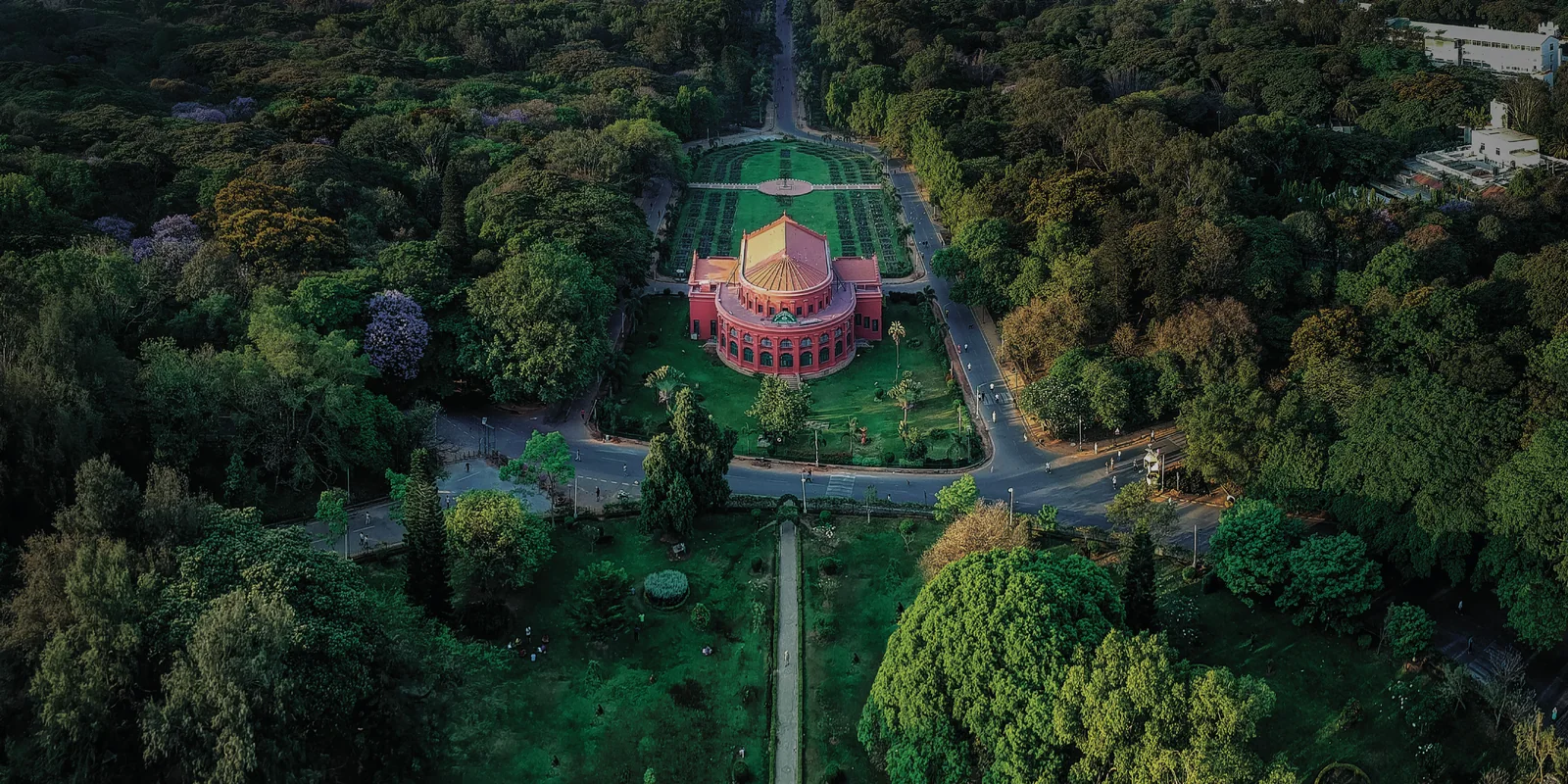
Living in central Bangalore means Lalbagh, Jayanagar, Basavanagudi, Richmond Town, Langford Town, Shanti Nagar, Indiranagar and Malleshwaram. What you get is a settled city: BWSSB Cauvery water in the taps rather than a tanker schedule, roads that were laid out before the traffic arrived, the Green Line metro already running past Lalbagh and South End Circle, and MG Road, Vidhana Soudha, KSR railway station and the big hospitals within fifteen to twenty minutes. Lalbagh’s 240 acres and Cubbon Park’s 300 are the city’s lungs, and they are protected land. The compromise is housing stock. Most of it is thirty to sixty years old, plots are small, parking is tight, and a new tower is an event rather than a weekly launch.
The corridors offer the opposite deal: large gated communities with every amenity on the brochure, bought new, usually at a lower rate per sq ft. The compromise is everything outside the gate. Many layouts on the periphery still depend on borewells and tankers even after the Cauvery Stage V expansion, a 10 km commute can take an hour, the low-lying eastern pockets have flooded more than once since 2022, and the neighbourhood you buy into is still under construction.
Cost of living in Bangalore
Housing is where the money goes. A 3 BHK in Jayanagar or around Lalbagh rents for ₹70,000 to ₹1.5 lakh a month in 2026, and an ultra-luxury 4 BHK in the centre runs higher. A comparable 3 BHK in the IT corridors is ₹50,000–80,000. On the buying side, the core costs more per sq ft and far less in daily commute time, which for a two-income household with children in central schools is the number that actually decides the question. Groceries, domestic help, cabs and dining remain moderate by metro standards.
Pros and cons of living in Bangalore
Pros: climate, job depth, a cosmopolitan population, healthcare of national standing, schools with waiting lists, and a social life that does not need a highway. Cons: traffic that has outgrown the road network, water insecurity on the periphery, flooding in low-lying areas during cloudbursts, patchy footpaths and waste collection, and housing costs that climbed faster than salaries between 2022 and 2024. The core avoids the first two of those cons for the most part; it does not avoid the last.
Best places to live in Bangalore
If your office is fixed, live within forty minutes of it at peak hour and ignore everything else. If your work moves around, as it does for founders, senior executives, doctors, lawyers and consultants, the centre wins because it is equidistant from everything: Lalbagh and Richmond Town for the CBD, Jayanagar and Basavanagudi for the established south, Indiranagar and Koramangala for the social side, Malleshwaram for old Bangalore with a metro line.
Is Bangalore good for investment?
Yes, provided you understand that the city has already had its sharp run and you are now buying for the steady part of the curve.
Bangalore property prices 2026: centre against corridor
Indicative asking prices for apartments, 2026. Registered rates run lower, and resale in older buildings trades at a discount to new launches.
| Locality | Zone | Indicative asking (₹/sq ft) |
|---|---|---|
| Lavelle Road / Vittal Mallya Road | CBD | 35,000–55,000 |
| Lal Bagh Main Road / Sudhama Nagar | Central | 27,000–30,000 |
| Jayanagar (3rd and 4th Block) | South-central | 19,000–22,000 |
| Indiranagar | East-central | 18,000–21,000 |
| Rajajinagar / Malleshwaram | West-central | 16,000–20,000 |
| Koramangala | South-east | 15,000–18,000 |
| Basavanagudi | South-central | 13,000–16,000 |
| Whitefield (core) | East corridor | 13,000–14,600 |
| Sarjapur Road / Hebbal | Corridors | 9,000–14,000 |
| Electronic City | South corridor | 6,500–9,000 |
Two things stand out. First, the centre is not uniformly expensive; Basavanagudi costs about the same as Whitefield. Second, the premium pockets have moved sharply even without new supply: Sudhama Nagar asking rates rose roughly 15% in the year to April 2026, and several reports in mid-2026 flagged Bangalore’s old-money neighbourhoods as the fastest-rising luxury segment in the city, precisely because almost nothing new is coming to them.
Rental yield in Bangalore
Gross yields in the corridors are 3–4.5%; in the core they are 2.5–3.5%. On a ₹9 crore home near Lalbagh that works out to roughly ₹1.9–2.6 lakh a month. The lower percentage comes with a different tenant: corporate leases for senior executives, consular and expatriate housing, medical and legal professionals who want to be ten minutes from work. Leases run longer, vacancies are shorter, and rent is paid on the first of the month. If you treat anything above 5% as a red flag, you will avoid most of the bad advice on this subject.
Why land is the real investment in central Bangalore
In the suburbs, land is typically 20–30% of a project’s cost and construction is the rest. At Purva Orient Grand, land is 52% of the RERA-filed cost. That ratio tells you what appreciates. Concrete depreciates from the day the occupancy certificate is issued; a 24-metre road frontage beside a protected botanical garden does not. Central Bangalore gets new homes only when a small old parcel is redeveloped, one tower at a time, with no next phase and no adjoining launch. Anarock’s Q2 2026 numbers show a quarter of all new units launched in the city were luxury, and hardly any of them were in the core. Scarcity is doing the work that infrastructure announcements do in the corridors.
What is driving demand across the city
Jobs first: Bengaluru took the largest share of India’s record GCC leasing in the first half of 2026, and office absorption leads housing demand by about a year. Transit second: the Green Line has served the core since 2017, the Pink Line’s underground stretch through Langford Town, Dairy Circle and MG Road is due in 2026–27 and will put Nagawara and the north within a single ride of Lalbagh, and the Blue Line to the airport is targeted for the end of 2027. Suburban rail out of KSR station is the long-dated bonus for anyone within three kilometres of it.
Is it worth buying a house in Bangalore in 2026?
Ask four questions. Will you hold for seven years or more? Is the water supply piped and documented? Is the title clean enough that a bank will lend 75% without a query? Is the price within 10–15% of recent registered resale in the same street? Four yeses and Bangalore is one of the more defensible places to put money in Indian real estate. For the core, add a fifth: would you still want this address if prices went nowhere for three years? If yes, you are buying for the right reason.
Best places to invest in Bangalore in 2026
The best areas to invest in Bangalore depend on what you want the money to do.
- Capital preservation with low vacancy: Lalbagh and Sudhama Nagar, Richmond and Langford Town, Lavelle Road, Jayanagar 3rd and 4th Block. Supply arrives only through redevelopment.
- Lifestyle plus rental: Indiranagar, Koramangala, Malleshwaram. Established, walkable, metro-linked, with steady tenant demand from people who refuse to commute.
- Yield: Whitefield, Electronic City and Sarjapur Road, where tenants work within a few kilometres and gross yields reach 4–5%.
- Long-horizon appreciation: the airport corridor in the north and the STRR belt in the east, where the transit is still under construction and the price has not fully caught up.
If you are comparing specific projects across these zones, our shortlist of the best residential projects in Bangalore in 2026 covers five villas and apartments in Central, North and East Bangalore.
The risks nobody puts in the brochure
For a purchase in the core, the risks are legal and physical rather than about demand.
Redevelopment titles. The parcel under a new central tower was usually an old bungalow or a partitioned family plot. Insist on A-khata, a thirty-year encumbrance certificate and the chain of sale deeds before the token.
Road widening and master-plan reservations. Several central arterials carry BBMP widening lines. Confirm the plot is outside them and that the setback is already accounted for in the sanctioned plan.
Parking and road width. Old neighbourhoods were planned for one car per house. Check the sanctioned parking ratio and the width of the approach road, because both affect resale.
Buying late in a project. Fewer units left usually means the best floors and the entry prices are gone. The trade is lower delivery risk, which has real value in a city where possession commonly slips by a year or more.
Across the city, the familiar risks remain: water on the periphery, traffic everywhere, a record pace of launches in 2026 that will leave some outer pockets oversupplied, and builders whose delivery record you have not checked.
Who should buy, and who should wait
Buy in the core if you are a family whose life is spread across the city, a business owner or professional who works out of the CBD, an NRI who wants an address that will read correctly in twenty years, or an investor who values low vacancy and liquidity over headline yield. Buy in the corridors if rental income is the goal and you have checked the water supply in writing.
Wait if your horizon is under five years, if you need more than 4% gross yield to make the numbers work, or if stretching to the core means compromising on size. A well-kept resale 3 BHK in Jayanagar or Basavanagudi is often the smarter central buy than a cramped new unit in a worse street.
Checklist before you buy property in Bangalore
- RERA number verified on the Karnataka RERA portal, with the completion date noted.
- A-khata, thirty-year encumbrance certificate, and the full chain of title on the land.
- Sanctioned plan checked for setbacks, parking ratio and any road-widening line.
- Water source stated in the agreement: BWSSB connection number, not “will be arranged”.
- Price compared against three registered transactions in the same locality in the last twelve months.
- The building’s occupancy certificate status, and what the developer has committed to if it is delayed.
- All-inclusive cost sheet in writing, including GST, stamp duty, registration, floor-rise, and club and maintenance deposits.
Where Lalbagh and Purva Orient Grand fit
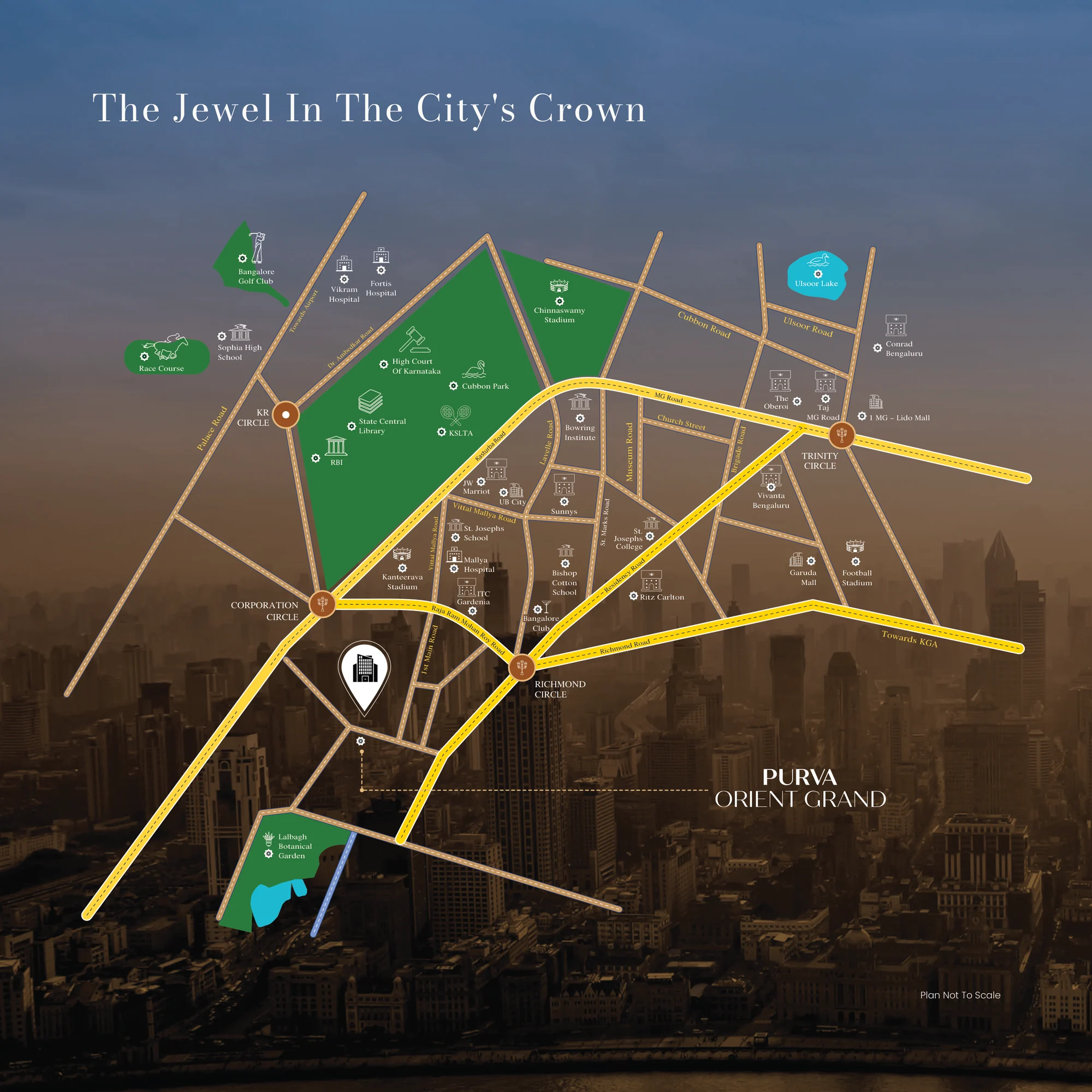
Lal Bagh Main Road is the clearest illustration of the central Bangalore case. Asking prices on the road average about ₹27,000 per sq ft in 2026, Lalbagh Metro on the Green Line is a five-minute walk, MG Road is ten minutes away, and the botanical garden next door cannot be acquired or built over.
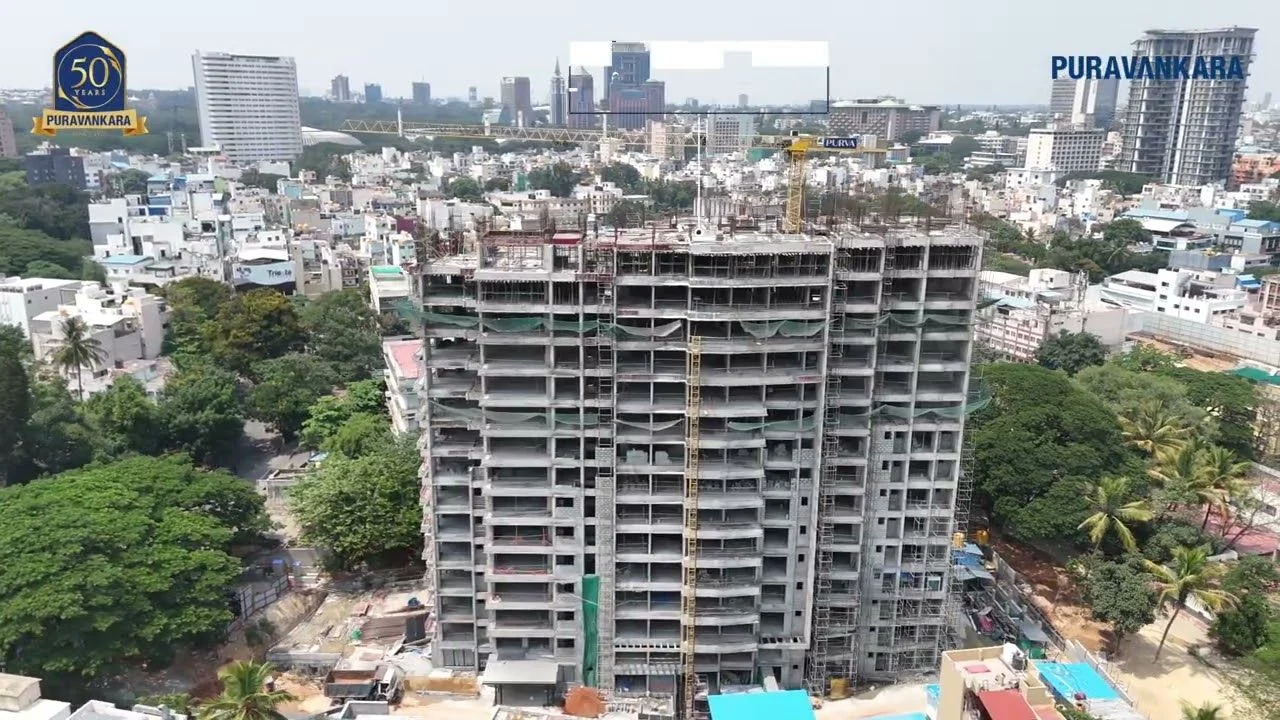
Purva Orient Grand is Puravankara’s WorldHome Collection tower on that road: 97 ultra-luxury 3 and 4 BHK residences in a single G+24 building on 1.15 acres at Sudhama Nagar, with no shared walls, a private deck to every home, and The Rose & Cypress rooftop club with an infinity pool on the 25th level. It launched at ₹6.00–10.78 crore and the current published entry is ₹9 crore onwards, which tells you the 3 BHKs and lower floors are largely gone and the larger, higher homes remain. The tower is in its final stages with RERA completion filed for 30 June 2027, so this is a late-stage buy with low delivery risk rather than a launch bet. The price page carries the rate per sq ft and the four grades, the configurations and floor plans show carpet and super built-up areas, the location and connectivity page lists drive times to the metro, schools and hospitals, and the amenities and master plan pages cover the rooftop club and the 75% open ground plane. There is a short note on the developer’s forty-year record on the About Puravankara page, and more guides to buying in Central Bengaluru on the blog.
Frequently asked questions
Is Bangalore a good place to live in 2026?▾
Is it better to live in central Bangalore or in the IT corridors?▾
Is Bangalore good for investment in real estate?▾
What is the rental yield in central Bangalore?▾
Which are the best areas to invest in Bangalore?▾
Is Sudhama Nagar near Lalbagh a good place to invest?▾
Are property prices in central Bangalore likely to fall?▾
Is a central Bangalore apartment a good buy for NRIs?▾
Contact Us
If you are weighing a home in central Bangalore, we arrange site visits at Purva Orient Grand seven days a week, including the rooftop level where access permits, and send a written all-inclusive cost sheet with live availability the same day. Call +91 63566 63535, message us on WhatsApp, or use the contact page.