
24 September 2026
Investor Brief · Central Bengaluru · 2026
CBD Bangalore Real Estate Investment: Why Land Scarcity Drives Long-Term Value
A plain-English reading of the land-cost ratio, the redevelopment-only supply pipeline, CBD price tiers and the Lalbagh factor, using Purva Orient Grand's own RERA filing as the worked example. No projections and no promises; just the structure of the market.
Contents
The Short Version
The case for CBD Bangalore real estate investment is not about amenities. Every ₹8 crore project in Bengaluru has an infinity pool. The case is about land — how much of a building's cost it represents, how rarely new land appears in the centre, and whether what surrounds it can ever change.
Three facts carry the argument:
- In Purva Orient Grand's own RERA filing, land is about 52% of total project cost. On a suburban project that share is typically 20 to 30%.
- New supply in Central Bengaluru arrives only through redevelopment of small parcels. There is no greenfield land left to release.
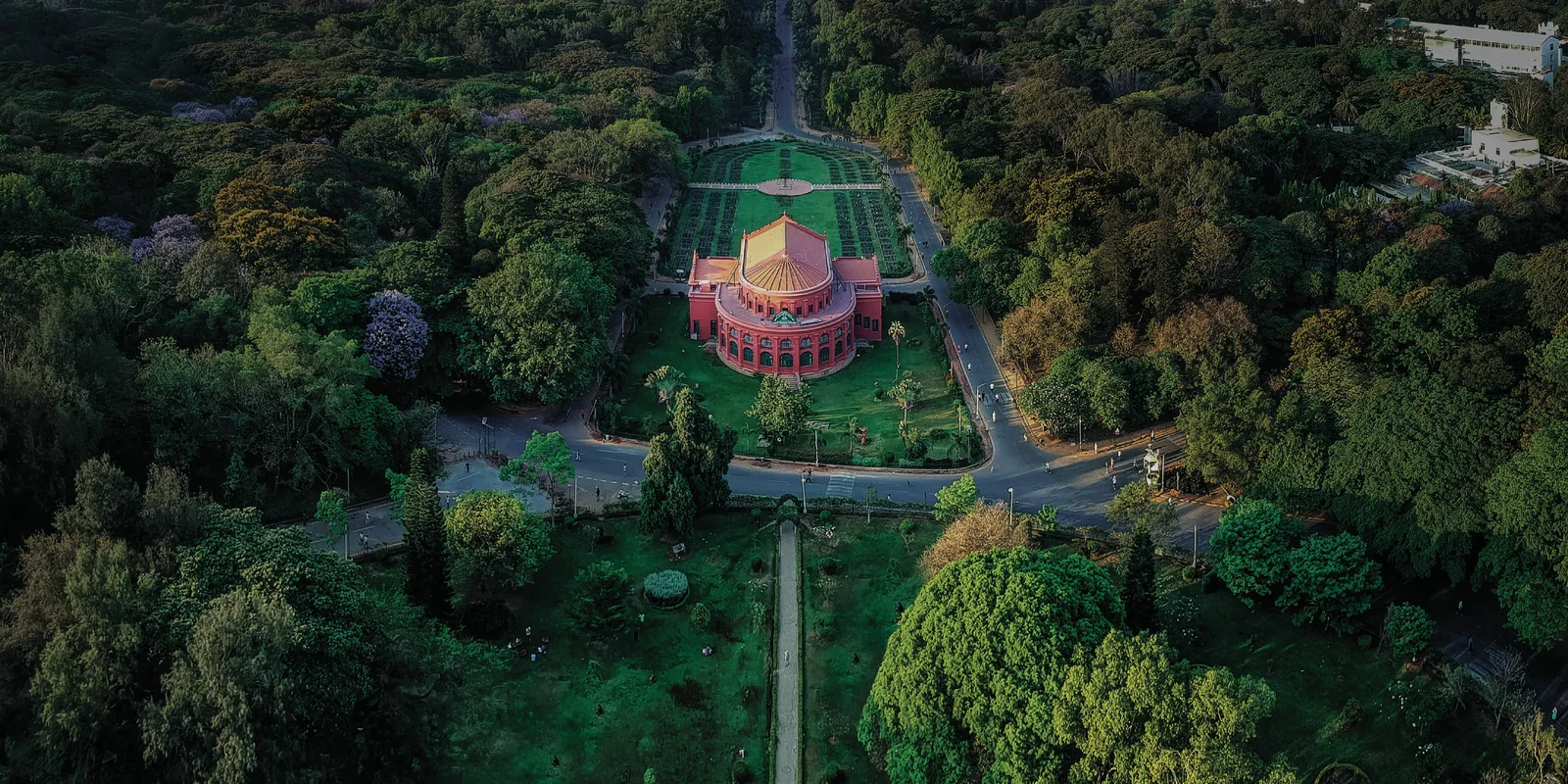
- Protected green cannot be built over. Lalbagh Botanical Garden's 240 acres, five minutes from the project, are permanent.
None of this guarantees a return. It explains why central Bengaluru is priced the way it is, and what an investor is actually paying for.
Read the RERA Filing: The Land-Cost Ratio
Developers file a project cost breakdown with Karnataka RERA, and it is one of the most useful documents an investor can read. Purva Orient Grand's filing puts total project cost at approximately ₹228 crore, of which land accounts for ₹119.4 crore — about fifty-two per cent.
Put simply, on a typical suburban project most of the money goes into concrete, steel, finishes and amenities. Here, more than half of it went into the ground. When land is more than half the cost of a building, it tells you something no brochure can: that the ground itself is the scarce input.
What the 52% does not tell you
The ratio reflects what land cost when the project was put together. It is not a valuation, and it says nothing on its own about future prices. It is a structural indicator — read it alongside everything else in the filing, and check the figures yourself on the Karnataka RERA portal.
Why Land Share Matters to an Investor
A building is a depreciating asset. Finishes date, services age, and a twenty-year-old tower competes against newer stock. Land does not wear out. When land is more than half of what it cost to create a project, more than half of what you are buying is the component that does not depreciate.
There is a second effect. Any future project nearby must buy land at the prices of its own day. That replacement cost sets a reference point for what new CBD homes must be priced at to be viable, which is part of why central Bengaluru pricing is anchored so differently from the suburbs.
Suburban markets tend to work the other way. Where land is plentiful and makes up 20 to 30% of cost, new supply can be added quickly on neighbouring parcels, and a larger share of the price you pay sits in the building rather than the ground.
Supply Arrives Only Through Redevelopment
Central Bengaluru stopped producing new residential land decades ago. What has been built here in recent years has come from redeveloping something small, which is why projects in the CBD are boutique by necessity, not by marketing choice. Projects of ten to sixty homes dominate the segment; 97 homes on 1.15 acres is a normal CBD format rather than an unusually small one.
For an investor this matters twice. There is no large launch waiting to flood the micro-market, and there is no later phase of the same project competing with your resale. At Orient Grand there is no adjoining launch and no second tower — the master plan is a single G+24 tower with parking in two basements and landscape across the ground plane.
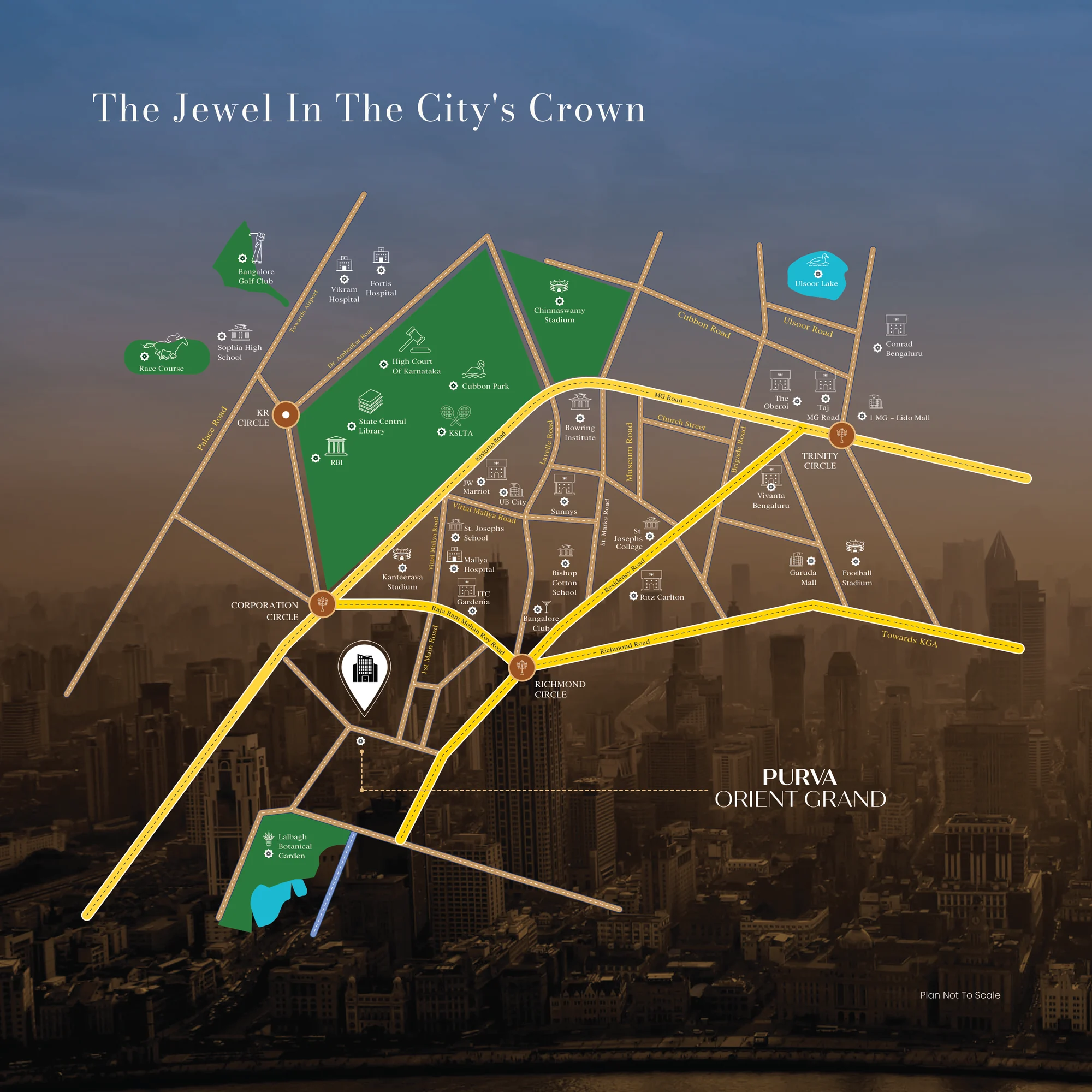
Location map from the official brochure. Plan not to scale.
CBD Price Tiers
Price tiering in the CBD runs roughly like this, on super built-up area:
Orient Grand sits at the top of the premium band, just under the ultra-premium core. The ranges are indicative, and an investor comparing projects should convert them to carpet-area rates, because loadings differ. At Orient Grand, carpet-to-super-built-up runs at approximately 60–67%, a consequence of its zero-shared-wall design and a rooftop club spread across only 97 homes. For illustration, a super built-up rate of ₹28,000 at 65% efficiency works out to roughly ₹43,000 per sq ft of carpet.
The launch range ran from ₹6.00 crore for the 3 BHK to ₹10.78 crore for the largest 4 BHK Grandeur. Puravankara's current published position is ₹9 crore onwards, which indicates that the larger, higher-floor residences are what remain. Grade-by-grade detail is on the price page and unit areas on the floor plans page.
The Lalbagh Factor
The Lalbagh adjacency is the irreplaceable part. Lalbagh Botanical Garden covers 240 protected acres and houses India's largest collection of tropical plants, including trees several centuries old. A protected botanical garden cannot be acquired, subdivided or built over. The low-rise green buffer around these homes is permanent, and permanence is precisely what a CBD buyer is paying for.
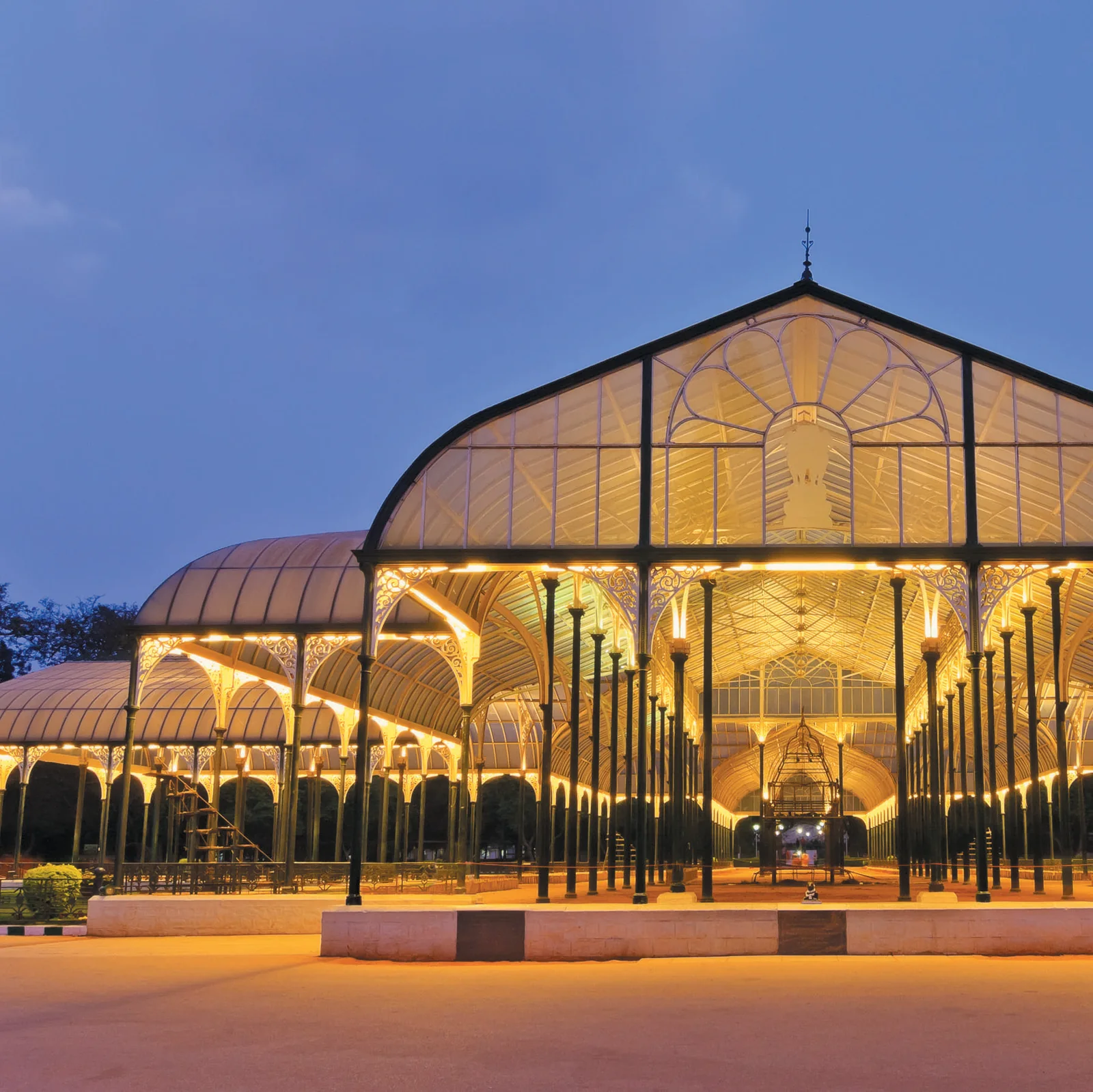
The Lalbagh Glass House. Lalbagh Botanical Garden is about five minutes from the project.
The same address is five minutes from Lalbagh Metro on the Green Line (approximately 0.5 km) and about ten minutes from MG Road Metro. The Bangalore Club, Cubbon Park and UB City are all within a short drive; see location and connectivity for the developer's published drive times.
Who Buys in the CBD
The buyer base here is not the IT-corridor buyer. It is corporate leadership, professionals with practices in the CBD, old-Bangalore families trading up within their own neighbourhood, and NRIs who want an address that will still read correctly in twenty years.
For an investor, the composition matters because resale demand comes largely from end-users rather than other investors. An end-user buyer base is generally steadier than a speculative one, but at this ticket size the pool is small, and a resale can take time.
What This Argument Does Not Promise
Nothing in this article is a forecast or a promise of returns. Property values can fall as well as rise, and the past performance of any market is not a guide to its future. Take independent financial, tax and legal advice before investing.
Weigh these honestly:
- Construction stage. Purva Orient Grand is under construction, in its final stages. The RERA-filed completion date is 30 June 2027 and the occupancy certificate has not yet been received.
- Liquidity. Large-ticket homes have a small buyer pool. Plan for a long holding period.
- Efficiency. A 60–67% carpet-to-super-built-up ratio means you pay for a meaningful share of common and amenity area.
- Rental income. Luxury homes typically yield modest rent relative to their capital value. We do not publish rental estimates for this project, and you should not buy it for rental yield alone.
- Concentration. A single ₹9 crore-plus asset is a concentrated position in any portfolio.
On the protective side: the project is registered with Karnataka RERA under PRM/KA/RERA/1251/310/PR/210907/004299, no appeals or complaints are recorded in the filing, and seventy per cent of amounts collected are deposited in a designated escrow account as required under Section 4(2)(l)(D) of the Real Estate (Regulation and Development) Act, 2016.
The Real Cost of Entry
Price per sq ft is not the whole cheque. In Karnataka, budget for:
For illustration, on a ₹9 crore agreement value, GST at 5% (₹45 lakh), stamp duty at 5–6% (₹45–54 lakh) and registration at 1% (₹9 lakh) together add roughly ₹0.99–1.08 crore before cess, premiums and other charges. Your actual liability depends on how the agreement is structured, so confirm it with your advisor.
An Investor's Checklist
- Read the RERA filing yourself — the cost breakdown, completion date and complaint history.
- Convert every quote to a carpet-area rate before comparing projects.
- Confirm live inventory. Know which grades and floors actually remain.
- Check the developer. Puravankara was founded in 1975 and has been listed on the BSE and NSE since 2007; see our Puravankara profile.
- Map the green. Establish what is in front of the home and whether it can ever change.
- Model the total cost of entry, including taxes, premiums and charges.
- Set your horizon. CBD property is a long-horizon holding, not a trade. The amenities and the address are what an eventual buyer will pay for too.
Frequently Asked Questions
Is CBD Bangalore real estate a good investment?▾
Why is Central Bengaluru priced so much higher than the IT corridors?▾
What is the land-cost ratio and where do I find it?▾
Where does Purva Orient Grand sit in the CBD price tiers?▾
Can I move into Purva Orient Grand now?▾
What taxes and charges apply when buying in Karnataka?▾
Ask for the live availability sheet.
Inventory at Purva Orient Grand is limited and the current published position is ₹9 crore onwards. We share what remains, floor by floor, rather than a generic price list.
Check Remaining Inventory